Key Sections
Direct lendingdirect lendingA strategy within private credit that typically involves a non-bank lender, like an investment firm or an asset manager, providing financing to private middle-market companies through a fund. is a strategy within private credit that typically involves a non-bank lender, such as an investment firm or asset manager, providing financing to private middle-market companiesmiddle-market companiesGenerally considered to be companies with $10 million to $500+ million in EBITDA through a fund. Instead of going to a bank for a loan, a company comes directly to investors — like Blue Owl — and we lend them the money directly without a bank in the middle.
Once viewed as an alternative to traditional bank financing, direct lending has become an increasingly important source of capital for middle-market businesses. For borrowers, direct lending can provide certainty, customized solutions, and access to long-term capital, while offering investors higher income potential, portfolio diversification, and performance across market cycles.
What is direct lending?
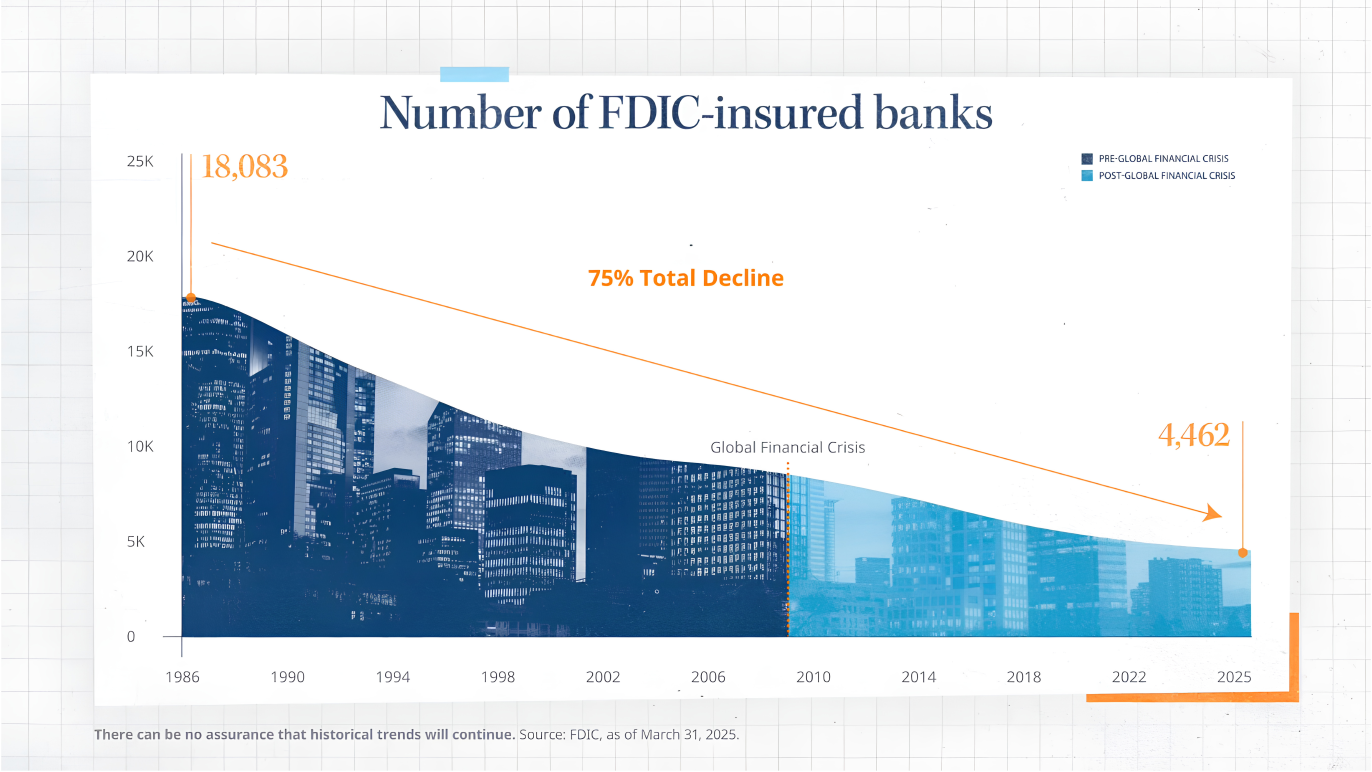
Direct lending has grown over time to meet the needs of the modern credit market. Historically, commercial banks were the primary source of financing for middle-market companies. However, after decades of bank consolidation and the 2008 financial crisis, banks shifted toward lending to larger clients and pulled back from lending to mid-sized companies. That left middle-market companies underserved, and direct lenders stepped in to fill the gap.
Unlike broadly syndicated lending via traditional banking, direct lending allows private companies to work directly with lenders who provide their financing. These loans are privately negotiated, often senior-securedsenior-securedA type of borrowing that stands first in line to be repaid and is backed by company assets. by company assets, and typically carry floating interest rates. Because direct lending loans are financed without a syndication process, lenders generally hold them for their full life (typically five to seven years). Being a buy-and-hold investor requires higher selectivity, and it also impacts how direct lenders structure their funds. The money raised from third-party investors — pension funds, insurance companies, wealth investors — is typically committed for longer periods, matching the multi-year nature of the loans themselves. This allows direct lenders to remain invested through different market conditions rather than being forced to sell a loan, potentially at a discount, during a period of uncertainty. It can also support a longer-term relationship with the borrower and ongoing oversight of the business.
What kinds of companies use direct lending?
Direct lending primarily serves middle-market companies, or businesses generally with EBITDAEBITDAIt is a financial metric used to measure a company's overall operational profitability and core performance. It stands for Earnings before interest, taxes, depreciation and amortization. ranging from $10 million to $500+ million. While these companies may not always be household names, many are large, established businesses with leading positions in their industries. Many are also sponsor-backed, which means that they are owned or invested in by another sophisticated investor, like a private equity firm, who also has an interest in the company’s long-term success.
Why do companies choose direct lending?
For borrowers, direct lending can offer more certainty and flexibility. Rather than relying on a broader group of lenders or accessing public markets, a company works directly with a single lender to structure financing around its specific needs and long-term goals.
Committed partnership: Direct lenders generally intend to hold their loans, supporting an ongoing relationship throughout the life of the investment.
Certainty: Greater certainty around financing, structure, and timing — direct lenders can evaluate the company, make a commitment, and close on a reliable timeline without the risk of a deal stalling because a bank can’t find enough buyers for pieces of the loan.
Customized solutions: Financing structured around a company's specific needs, including its business model, current capital needs, and long-term growth plans. Because direct lenders work directly with the company and its private equity owners over the life of the loan, direct lenders better understand the business and can support its future needs, like acquisitions or additional capital.
Convenience: Direct lending lets management stay focused on running the business. It’s a privately negotiated process without the same ratings, roadshow, or broad syndication process necessary when securing financing via a public debt issuance.
Confidentiality: Because the loan isn’t broadly sold or publicly traded, fewer parties are involved, which helps companies keep sensitive business information private.
What are the benefits of direct lending for investors?
Direct lending can offer investors a differentiated source of income and return potential through contractual interest payments on privately originated loans.
Higher income potential, paid out more predictably: Direct lending has historically generated returns of roughly 8-10% a year, more than comparable public loans and bonds, and closer to the historical return profile of stocks.1 This higher return potential comes with a trade-off, as the fund structures needed for these assets require investors’ money to be held for a longer period of time, given the buy-and-hold nature of the underlying loans. Direct lending aims to distribute income to investors regularly through distributions, rather than relying on a one-time gain from selling a stock at the right time.
Built for various rate environments: Because many direct lending investments are floating-rate loansfloating-rate loansFloating-rate loans are loans whose interest rates change over time instead of staying fixed. The rate is typically a benchmark (like SOFR or the prime rate) plus a set markup, so when the benchmark rises or falls, the interest rate and respective payments move with it. , when rates go up, the income paid to investors can go up too — unlike most bonds, which tend to lose value as rates rise. As a result, investors aren't relying on a particular interest rate outcome to drive returns; performance is driven mostly by income and underlying credit quality.
Structural protection: Because direct lending frequently sits senior in the capital structure, or, higher in a company’s repayment order, direct lending loans are paid back first, which is designed to help manage downside risk.
Active portfolio construction: Direct lending portfolios are constructed loan by loan and sector by sector. This allows managers to be deliberate and selective across companies, industries, and parts of the capital structure while managing portfolio-level concentration. As a result, default and loss rates have historically run well below the broader market.
How does direct lending support the economy?
Direct lending provides private companies with capital to support growth, from hiring employees and expanding operations to investing in new products, technology, and other strategic priorities. Over 80% of US companies with more than $100 million in revenue are private, and these high-quality companies are staying private for longer. The upper-middle-market alone represents roughly 200,000 businesses, generates about a third of US GDP, and employs more than 48 million people.2 For middle-market companies without the same access to bank financing as larger businesses, direct lending can provide an important source of financing.
By complementing banks and the public capital markets, direct lending can broaden the sources of financing available to businesses and help maintain access to capital across market environments. In doing so, direct lending connects long-term capital to companies that contribute to employment, investment, and economic activity, helping keep the overall system more resilient.
How does Blue Owl approach direct lending?
At Blue Owl, our goal has always been strong returns while protecting investors on the downside. Our approach to direct lending begins with disciplined investment selection. Our scale gives us access to a broader opportunity set, but selectivity, rigorous underwriting, structural protection, and portfolio construction ultimately determine how and where we deploy capital.
Scale: Blue Owl has originated hundreds of billions in direct lending loans and partners with more than 150 private equity firms. This has provided access to a broad opportunity set, supported larger financing solutions, and helped position Blue Owl-managed funds as reliable capital partners across market cycles.
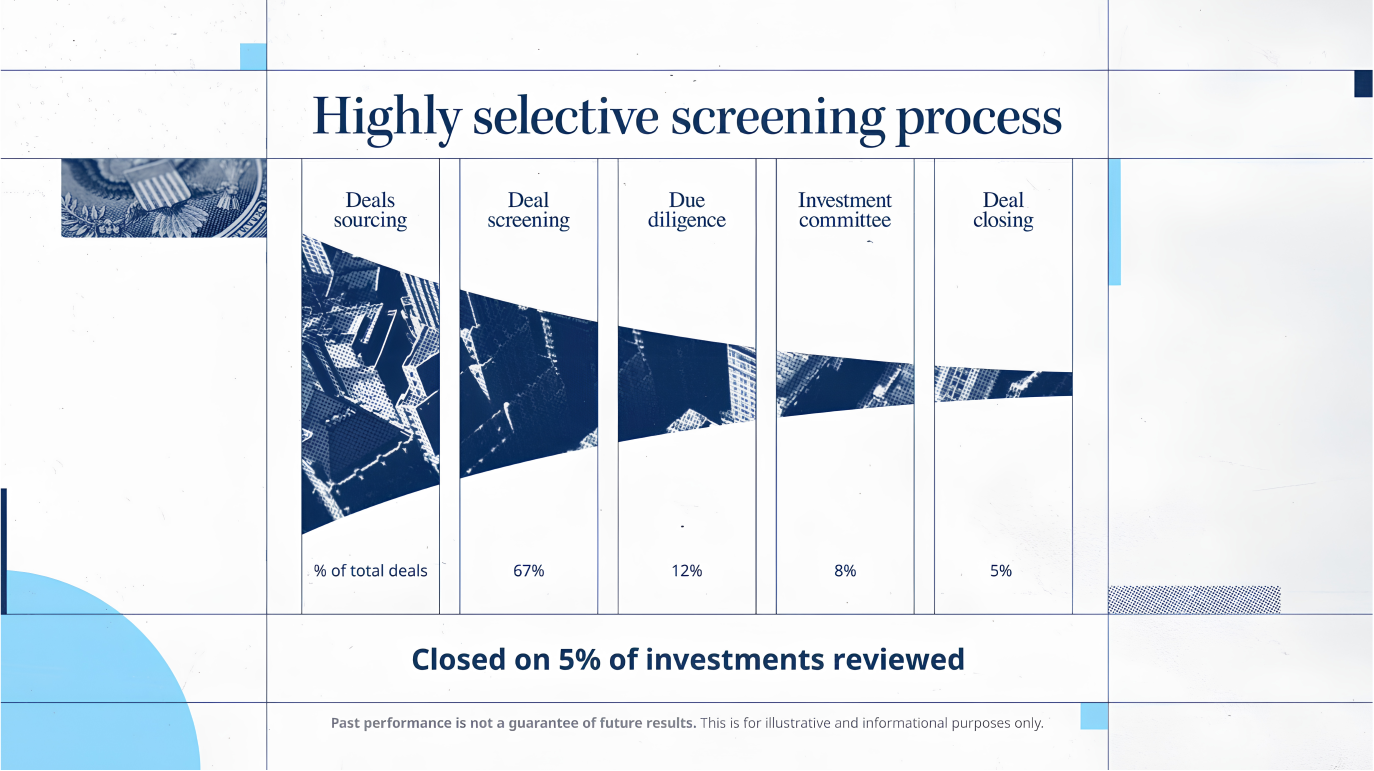
Selectivity and discipline: Rigorous screening, due diligence, and stress testing inform our investment selection. Our target companies are sponsor-backed; market leaders in stable, recession-resistant industries with recurring cash flows; and we focus on the upper-middle-market. The weighted average EBITDA for Blue Owl’s portfolio companies is on the higher end of the market at over $200M. Our investment process is highly selective: for every 100 opportunities reviewed, approximately five move forward to close.
Structural protection: More than 90% of Blue Owl's loans are senior secured, and we typically lend at approximately 40% loan-to-value, providing structural protection within the capital structure. As an example: A private equity firm buys a company for $10 billion. To do that, they use ~$6 billion of their own money. We lend ~$4 billion. That is a 40% “loan-to-value”. In a hypothetical scenario where that business loses half its value and is only worth $5 billion, our loan would still be covered because it is senior secured, and we would get our ~$4 billion of capital back first.3
Diversification: Our exposure across hundreds of companies and multiple industries helps to limit concentration in any single company and sector. Our target is for no single loan to represent more than 2% of the portfolio, so our performance is not dependent on any single company or sector.
Endnotes
Bloomberg, Cliffwater, May 2026.
Source: National Center for the Middle Market (2026); Chubb Middle Market Indicator; PitchBook (2026).
For illustrative purposes only. This hypothetical example is simplified and does not reflect any actual investment or guarantee the repayment or recovery of principal. Actual outcomes will depend on the specific terms, collateral value and other circumstances of the investment.
Important information
Unless otherwise noted the Report Date referenced herein is as of September 30, 2026.
Past performance is not a guarantee of future results.
The material presented is proprietary information regarding Blue Owl Capital Inc. (“Blue Owl”), its affiliates and investment program, funds sponsored by Blue Owl, including the Blue Owl Credit, Real Assets, and GP Strategic Capital Funds (collectively the “Blue Owl Funds”) as well as investment held by the Blue Owl Funds.
The views expressed and, except as otherwise indicated, the information provided are as of the report date and are subject to change, update, revision, verification, and amendment, materially or otherwise, without notice, as market or other conditions change. Since these conditions can change frequently, there can be no assurance that the trends described herein will continue or that any forecasts are accurate. In addition, certain of the statements contained in this material may be statements of future expectations and other forward-looking statements that are based on the current views and assumptions of Blue Owl and involve known and unknown risks and uncertainties (including those discussed below) that could cause actual results, performance, or events to differ materially from those expressed or implied in such statements. These statements may be forward-looking by reason of context or identified by words such as “may, will, should, expects, plans, intends, anticipates, believes, estimates, predicts, potential or continue” and other similar expressions. Neither Blue Owl, its affiliates, nor any of Blue Owl’s or its affiliates’ respective advisers, members, directors, officers, partners, agents, representatives or employees or any other person (collectively the “Blue Owl Entities”) is under any obligation to update or keep current the information contained in this document.
This material contains information from third party sources which Blue Owl has not verified. No representation or warranty, express or implied, is given by or on behalf of the Blue Owl Entities as to the accuracy, fairness, correctness or completeness of the information or opinions contained in this material and no liability whatsoever (in negligence or otherwise) is accepted by the Blue Owl Entities for any loss howsoever arising, directly or indirectly, from any use of this material or its contents, or otherwise arising in connection therewith.
All investments are subject to risk, including the loss of the principal amount invested.
These risks may include limited operating history, uncertain distributions, inconsistent valuation of the portfolio, changing interest rates, leveraging of assets, reliance on the investment advisor, potential conflicts of interest, payment of substantial fees to the investment advisor and the dealer manager, potential illiquidity, and liquidation at more or less than the original amount invested.
This material is for informational purposes only and is not an offer or a solicitation to sell or subscribe for any fund and does not constitute investment, legal, regulatory, business, tax, financial, accounting, or other advice or a recommendation regarding any securities of Blue Owl, of any fund or vehicle managed by Blue Owl, or of any other issuer of securities. Only a definitive offering document (i.e.: Prospectus or Private Placement Memorandum) can make such an offer.
Copyright© Blue Owl Capital Inc. 2026. All rights reserved.
This material is proprietary and may not be reproduced, transferred, or distributed in any form without prior written permission from Blue Owl. It is delivered on an “as is” basis without warranty or liability by accepting the information, you agree to abide by all applicable copyright and other laws, as well as any additional copyright notices or restrictions contained in the information.