Key Sections
Watch our In Focus Webcast
Leaders from across our business discuss key themes and potential opportunities for our investment platforms in 2026.



In Focus: Private Credit
Durability, momentum, and an expanding opportunity set
After more than a decade of expansion, private credit has reached a scale and level of influence that underscore its importance. Drawing on our perspective as a scaled lender and leader across the private credit ecosystem, we assess the key themes in private credit today and how the asset class is positioned for 2026:
Direct lending is proving durable in an evolving backdrop.
Yields are normalizing from multiyear highs as interest rates decline. However, return premiums on direct lending continue to be supported by demand for flexible solutions, and credit performance remains resilient, highlighting the strategy’s potential “all-weather” appeal for investors.
Private credit’s opportunity set is larger than ever.
Investor momentum remains strong, M&A activity is picking up, and the maturation of private credit is driving growth in adjacent areas such as Asset-Based Finance (ABF) and, more recently, digital infrastructure.
Theme 1 | Direct lending's return premium and credit performance have proven durable
Two of the most common investor concerns today are: 1) the outlook for direct lending returns in an environment of falling interest rates and tight credit spreads, and 2) the potential for deteriorating credit quality.
Return premiums
Over the past several years, rising base rates boosted yields on floating-rate loan portfolios. In a declining rate environment, yields tend to normalize naturally. However, throughout varying environments, the return premium for direct lending has been remarkably consistent. Over the last three years, direct lending has maintained an average 250 basis point yield premium to public loans,1 and we believe that direct lending portfolios can continue to offer a meaningful premium to public credit markets in the year to come.
In our view, this premium reflects the certainty of execution, structural flexibility, and bespoke financing solutions that private lenders can provide. These attributes appear to remain highly valued by financial sponsors. Over the last twelve months, roughly 85% of LBO financings were executed in the private credit market,2 underscoring private credit’s strategic relevance and durability, even in more competitive environments.
Credit quality
Private credit’s rapid growth over the past decade has also created natural skepticism about the durability of credit quality. Market commentators have repeatedly anticipated a wave of underperformance—citing record capital deployment in 2021, rising rates in 2022 and, more recently, idiosyncratic bankruptcies in other markets or perceived risks associated with AI-driven disruption. Yet the widely predicted deterioration has not materialized to date.
Instead, credit performance has remained remarkably resilient. Public market defaults currently stand at approximately 1.25%, well below the historical average of roughly 2.5%.3 We believe direct lending portfolios have entered 2026 in a position of clear strength, with no signs of systemic stress.
Key takeaway: Direct lending, which we believe has proven itself as an all-weather asset class, appears well positioned to build on current momentum throughout 2026.
Theme 2 | Private credit’s opportunity set remains attractive
Private credit’s strong growth has also raised concerns about the acceleration of capital flowing into the space relative to the size of the opportunity set. We believe investor momentum should continue in 2026 and that the institutionalization of private credit may continue, expanding the investable universe.
Investor momentum
2025 was a strong year for fundraising, with more than $165 billion allocated to private credit, roughly $95 billion of which was raised in direct lending.4 This continued momentum reflects the growing global adoption of private credit across both institutional and private wealth channels.
In our view, a few forces are driving this expansion. First, direct lending has delivered on investor expectations: relative returns have remained attractive, with an average yield premium of roughly 250bps over the last three years; and, the volatility profile continues to compare favorably to public markets in times of stress, with total return outperformance of roughly 65% during the COVID-19 pandemic and 110% during the more recent regional bank crisis.5 Second, private credit solutions are becoming more accessible. Innovations in product structures have broadened availability to a wider set of investors, including private wealth platforms. More recently, private credit expanded into defined-contribution channels, a development that could meaningfully increase the addressable investor base over time.
The expanding opportunity set
The rapid inflow of capital into private credit has raised questions about the size of the available opportunity set. However, the reality is that the addressable market appears to be larger than ever,6 and the continued institutionalization of private credit is driving further expansion of the opportunity set.
We have already begun to see a pickup in M&A activity. The first three quarters of 2025 tracked to the five-year average,7 and we expect a lower rate environment may further stimulate transaction volume. More activity could directly translate into a larger pool of financing opportunities.
Additionally, private credit continues to grow its market share (Fig. 2). Direct lending has progressively migrated upmarket and become more institutional, unlocking a growing opportunity set of financings. Over the first three quarters of 2025, more than $58 billion of $1 billion+ direct lending deals were completed—compared with only $6 billion five years ago,8 demonstrating that sponsor reliance on private credit for the largest, most strategic transactions has increased markedly.
At the same time, the opportunity set is expanding into adjacent areas. For instance, the maturation of private credit has given rise to growth in ABF.
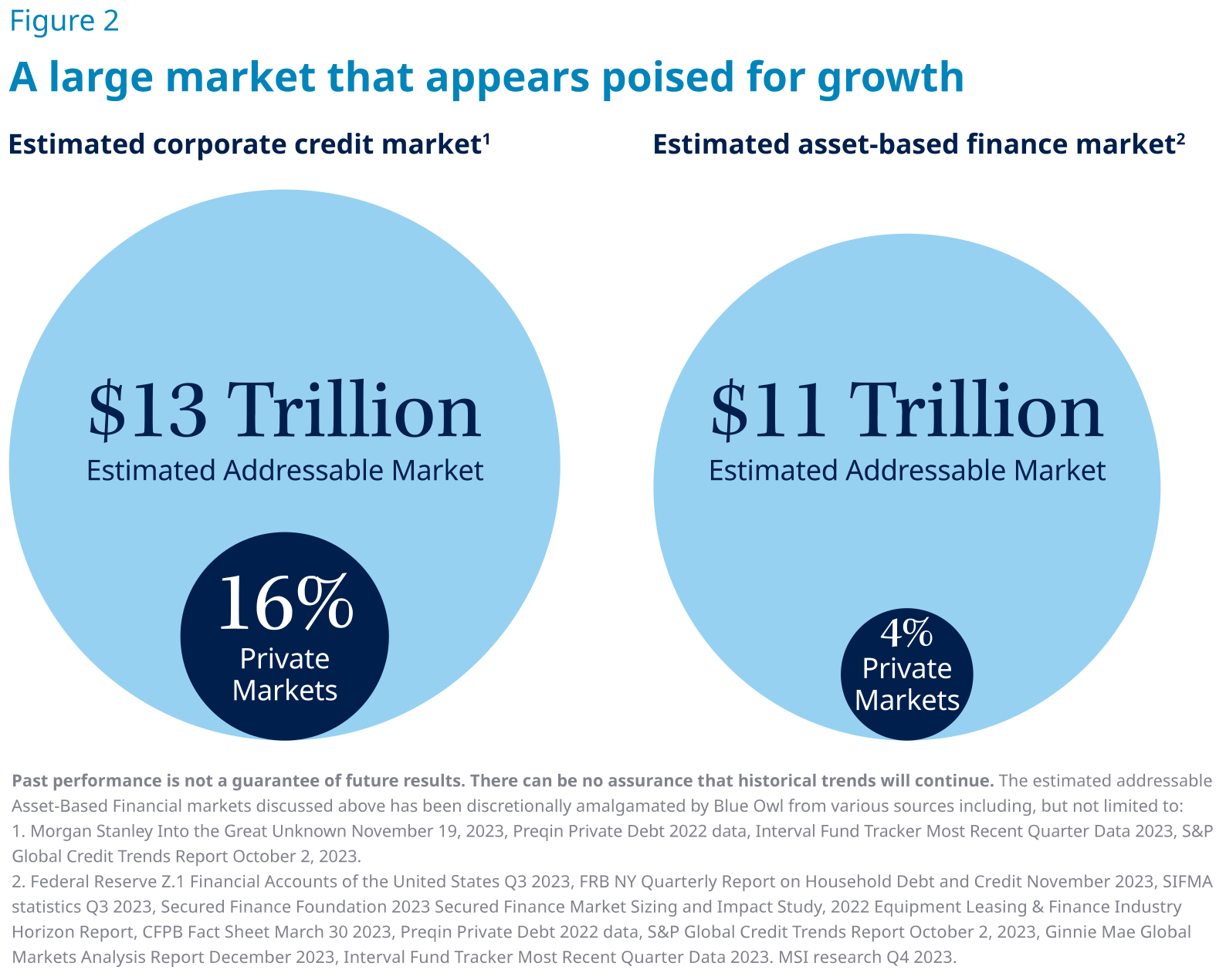
The ABF market, in particular, reminds us of the direct lending market a decade ago, marked by continued bank retrenchment in a growing asset class with attractive credit characteristics. We estimate the total addressable market for ABF to be $11 trillion+,9 comprising opportunities from consumers, small businesses, leases, and equipment. The market supports ubiquitous, everyday transactions such as credit cards, air travel, or mortgage payments, and we believe it can generate returns that complement direct lending and traditional 60/40 portfolios. The space is severely underserved with less than $500 billion dedicated fund manager AUM,10 affording scaled players with differentiated sourcing, dedicated capital and expertise, and the requisite infrastructure, the opportunity to capture meaningful market share and partner with large, higher-quality counterparties.
Both ABF and digital infrastructure typically share many of the characteristics that have historically made direct lending attractive: defensive credit characteristics and opportunities for selective participation that can enhance portfolio construction and broaden sources of return.
Scaling successfully into these markets, however, requires meaningful resources: substantial capital, large, specialized teams, and deeply entrenched relationships. For this reason, we believe scaled lenders with multi-disciplinary capabilities will be the biggest beneficiaries of private credit’s expanding opportunity set in 2026 and beyond.
Key takeaway: Direct lending’s trend towards institutionalization continues, broadening the investor universe and growing the addressable opportunity set across traditional sponsor finance and adjacencies such as ABF.
Conclusion
Private credit appears positioned for performance and growth
We believe the asset class is well-positioned as we enter 2026.
Momentum remains strong, adoption is expanding globally, and the investable universe continues to widen as the market institutionalizes and evolves. At the same time, credit performance has remained healthy, and the fundamental value proposition—such as the potential for attractive returns, capital preservation, and structural seniority—remains intact.
Private credit currently accounts for less than 25% of the overall leveraged credit market. By the early 2030s, that figure is expected to reach 30%,11 underscoring the continued runway for growth. Given the historical return premium, observed credit resilience, and a continually broadening opportunity set, we believe the asset class remains not only well-positioned for the year ahead but compelling for investors looking to deploy capital today.
At Blue Owl, we believe our scale and experience position us to participate in the growing opportunity set. As the market has evolved, we have developed capabilities to finance large transactions, structure bespoke solutions, and play a leading role in select deals.
In Focus: Real Assets
The intersection of growth and private capital
Private real asset strategies sit at the intersection of two meaningful trends: global economic growth and the accelerating shift toward private capital. From cloud and AI, to energy, healthcare, and other essential sectors, we believe companies are increasingly turning to private capital to help build and support the mission-critical infrastructure that powers their growth.
As a global leader in net lease, real estate credit, and digital infrastructure, our goal in this piece is to share key insights across these essential sectors of the private markets:
Digital infrastructure is a secular opportunity.
Cloud computing and digital services form the backbone of the modern economy, and rising demand for infrastructure is a durable, multi-year trend. While near-term volatility around the AI theme may increase, digital infrastructure remains one of the most compelling long-term opportunities in private real assets.
Real asset opportunities are expanding.
While data centers dominate headlines, private capital can create more opportunities to invest in other essential sectors—such as energy, healthcare, and logistics—where underlying demand can be large and driven by secular, not cyclical, forces.
Scaled, flexible capital solutions can be critical to capturing real asset opportunities.
In today’s market, capital requirements are often very large, and tenants are likely to be global and sophisticated with increasing needs for customization. The ability to deliver scaled solutions with speed and reliability of execution can help to secure high-quality tenants, mission-critical assets, favorable pricing, and appropriate downside risk mitigation.
We believe the opportunity favors investors who can pair specialized sector insight with scale and flexibility across the capital stack, and the conviction to lean into themes supported by clear, long-term demand. Direct insights help investors focus on what matters most: deploying capital toward the most durable opportunities and filtering out short-term noise.
Theme 1 | The digital backbone: AI, data centers, and a market in transition
Data centers are the digital backbone of the modern economy. These specialized facilities house powerful computing resources to manage, process, and store the vast amounts of data created every day. Cloud computing and other digital services depend on data centers, and demand for capacity is rapidly outpacing supply.
Artificial intelligence is supercharging this secular growth in demand. Advances in model sophistication, training intensity, and inference are expanding the need for power, compute, and highly specialized facilities.
The long-term trajectory is clear. Accelerating digitization and exponential growth in AI workloads are likely driving demand for more cloud storage and compute, and increasingly dense, power-intensive facilities. Major players such as Google, Microsoft, and Amazon report backlogs in contracted spend for cloud and AI infrastructure in the hundreds of billions of dollars (Fig. 1). Hyperscalers are planning multi-gigawatt campuses, and global data center expenditures are expected to increase to $7 trillion by 2030 to meet this demand.1
Unlike past speculative cycles, today’s buildout is led by investment-grade2 hyperscalers under long-term take-or-pay agreements, anchoring demand visibility and mitigating termination risk. Physical constraints, such as power availability and multi-year permitting timelines, create natural barriers to oversupply, reinforcing the durability of this theme.
While many hyperscalers are investing to meet long-term structural demand over a multi-year horizon, investors are likely grappling with nearer-term concerns. AI-related equity valuations are stretched, driven by the amount of capital seeking exposure to the AI theme.
However, these issues do not change the fundamental picture. Historically, transformational infrastructure cycles— railroads, broadband, fiber, renewable power—often featured speculative elements early on. These periods did not negate the underlying secular trend; they underscored the scale of the long-term transition underway.
The same dynamic applies today. Despite valuation noise, the case for sustained investment in digital infrastructure is grounded in fundamentals: power scarcity, long development lead times, hyperscaler commitments, and the indispensable role data centers play in economic and industrial productivity. These factors are not cyclical—they reflect the structural rewiring of the economy. This is not about picking winners among AI models. It’s about owning the essential infrastructure that underpins the global economy—real assets engineered for resilience, scalability, and decades of utility.
Key takeaway: Secular growth in data and cloud computing are driving a multi-decade digital infrastructure buildout that we believe continues to define one of the most compelling long-term opportunities in private real assets.
Theme 2 | Beyond tech infrastructure: the expanding opportunity set
While data centers are a focus of headlines, a broader set of essential real assets can present equally strong risk-adjusted opportunities. Many of these sectors share attractive characteristics: long-term leases, potentially predictable cash flows, and demand drivers that are rooted in structural, not cyclical, forces.
Market dynamics create an opportunity to be highly selective. When evaluating these opportunities, we look across three intersecting lenses:
Market size:
We focus on sectors where underlying demand is large, growing, and supported by factors that tend to be less sensitive to traditional real estate cycles. Examples include:
- Industrial outdoor storage (IOS) and cold storage: Integral to logistics, transportation, equipment staging, and last-mile distribution.
- Healthcare real estate (medical offices, hospitals): Driven by aging demographics and the shift toward outpatient care.
- Energy and power assets: Anchored by “essential use” demand and their role in powering the digital and industrial economy.
Risk-return profile:
In sectors with a large addressable market, we look for opportunities where yield, growth, and capital preservation combine favorably. Providing capital alone is insufficient. We look for partnership relationships where we can be compensated for expertise, speed, scale, and structural flexibility.
Competitive advantage:
Specialized expertise is critical, and we look for areas where we have a competitive advantage. Some sectors are highly specialized (e.g., defense housing, cold storage), which can be a barrier to entry.
Growth catalysts: reduced bank lending and a wall of maturities
We see several catalysts for an expansion in the opportunity set for 2026. First, banks continue to withdraw from commercial lending. Second, more than $3 trillion in commercial real estate debt is set to mature by 2030 (Fig. 2). Refinancing rates are higher, and companies tend to look for the scaled solutions and flexibility that private capital can provide.
From a value perspective, commercial property values are down ~20% from early 2022. This repricing allows lenders to extend credit at lower loan-to-value ("LTV") ratios (typically 60–65% versus 70%+ in past cycles), implying less risk at higher returns (Fig. 3). Based on current credit spreads, SOFR yields, and typical origination fees, a new commercial real estate loan could mathematically result in a total return of 8% or more, compared to approximately 4% in 2022.3
In our view, a selective approach in sectors that might meet the right criteria can provide a differentiated return profile, balancing current yield, inflation protection through rent escalators, and exposure to long-lived secular demand trends.
Key takeaway: Commercial real estate appears to be facing a wall of maturing debt amid a secular decline in bank lending. We believe these long-term trends can create new opportunities for private capital seeking to provide flexible solutions with attractive economics on a highly selective basis.
Theme 3 | Flexible, scaled capital solutions will be critical to navigating a more complex market
We believe the combination of scale and the ability to invest creatively across the capital stack—spanning both public and private markets—can be essential to capturing today’s real estate opportunity. The AI infrastructure build-out is inherently capital-intensive, and the broader opportunity set across real assets is expanding and globalizing, with counterparties requiring more tailored and sophisticated capital solutions. These include private debt (either via origination or acquisition of loans), debt securities, and bespoke solutions.
The ability to move with speed, scale, and certainty of execution can help secure access to mission-critical real assets, potentially achieve favorable pricing, and mitigate to risk.
In a complex market environment, the ability to flexibly structure solutions across development financing, acquisition capital, loan refinancings, and participation in public markets (commercial real estate securities) will be increasingly valuable. This toolkit helps support thoughtful, customized outcomes for counterparties, and compelling return potential for investors.
Key takeaway: Today’s real asset opportunities are more capital intensive and more complex. The ability to move with speed, scale, and certainty of execution can help secure access to mission-critical real assets, potentially achieve favorable pricing, and to mitigate risk.
Conclusion
Capturing the opportunity in a market defined by structural change
Today, we believe private real asset markets sit at the intersection of powerful structural forces.
AI adoption and digitalization are accelerating demand for power, compute capacity, and highly specialized infrastructure. Essential real assets sectors— healthcare, logistics, and power—are increasingly seeking flexible financing solutions. At the same time, higher financing costs and reduced bank lending are reshaping capital flows across commercial real estate.
In our view, these dynamics can create outsized opportunities that call for a selective, flexible approach, anchored in scale, speed, and structural expertise.
In Focus: GP Strategic Capital
Investing in the future of private markets
GP stakes have become a critical capital solution for the private markets ecosystem and continue to develop as a distinct asset class. As the industry matures, its capital needs seem to be rising. GP co-investment expectations are higher, large funds are capturing a greater share of inflows, firms are adding new products and strategies, and, after 20-30 years of value creation, generational transition is a natural focus for many founding partners. With GP commitments in prior vintages also taking longer to return, we have found GP stakes are increasingly viewed as an attractive way to support growth, reinforce balance sheet strength, and manage succession.
Private markets now appear to be the backbone of global business ownership, with embedded multi-year structural growth drivers. The value in private markets is not just in the deals, but in the firms with the capabilities, insight, and scale to potentially create value repeatedly. At a time when the industry is consolidating around larger, more scaled platforms and specialists, GP stakes can offer allocators diversified ownership of the firms driving the expansion of the private markets ecosystem, and exposure to the secular public-to-private theme that cannot easily be replicated in the public markets.
Here are trends we see across private capital markets:
Fundraising is structurally global and multi-channel.
Capital formation now spans global pension systems, sovereign wealth funds, insurers, and rapidly expanding wealth channels. In a world where capital is coming from more places, through more channels, and with more technical requirements, managers with multi-channel infrastructure and global reach are structurally advantaged.
The generalist model is yielding to specialists.1
Managers with deep domain expertise are benefitting from a self-reinforcing cycle: focus brings insights that drive performance. Specialist strategies have tended to show higher return persistence and lower dispersion versus generalists, which has contributed to more capital flowing to specialists. Rising capital reinforces specialist capabilities, leading to more focus and insights.
Private markets are healthy and growing.
Private markets have become the dominant form of corporate ownership. Institutional investors dominate allocations, and allocators want to build exposure to the parts of the economy where capital formation actually happens. Growth of the asset class reflects structural, not cyclical, forces.
Perceptions are skewed by the 2021-2022 boom in venture capital (VC) and growth strategies.
VC and growth are cash-negative strategies, often relying on exit events rather than recurring cash flows to generate returns. Exit delays have meant that even healthy underlying companies have provided little realized return. Other private-market strategies—buyout, credit, secondaries, and infrastructure—remain fundamentally resilient.
Theme 1 | Follow the flows: fundraising is structurally global and multi-channel
Fundraising is no longer driven by a single region or investor type. Capital is now sourced from an increasingly global array of allocators: Latin American pensions,2 Asian insurers,3 Middle Eastern sovereign funds,4 private banks in Singapore and Hong Kong,5 and European wealth platforms6 —all of which are becoming meaningful contributors to capital formation.
Each channel responds to different forces:
- Pensions follow long-term schedules and are typically less sensitive to short-term dislocation.
- Insurers tend to allocate based on regulatory treatment, liability-matching, and yield dynamics.
- Wealth flows are generally sensitive to sentiment, brand recognition, and product structure.
- Sovereigns can behave opportunistically or strategically, depending on macro conditions.
The result is a multi-speed fundraising environment where global macro conditions, currency cycles, and local regulation can accelerate flows in some pockets while slowing them elsewhere. A synchronized upcycle is no longer the norm. While pockets of weakness tend to get more attention (see Theme 4), overall fundraising appears to remain in cash-flow equilibrium. Capital inflows and outflows have generally continued to balance, which may reflect a healthy, maturing system rather than signs of fatigue.
In this environment, scale and distribution reach are becoming decisive advantages. Managers with multi-channel infrastructure and local presence can capture inflows where they occur and offset softness in other regions. Wealth channels, which are emerging as the incremental growth engine, require substantial investment in LP education, product design, and client service, which can also benefit managers with scale.
Insurance capital is also reshaping flows into private credit, real assets, and long-duration strategies. Insurers increasingly prefer large partners capable of navigating risk-based capital rules, asset-liability matching, and portfolio-level reporting.
Key takeaway: In a world where capital is coming from more places, through more channels, and with greater technical requirements, scale and global reach have become structural advantages.
Theme 2 | The rise of the specialist firm
The generalist era is giving way to a model built around deep specialization. Across private equity, private credit, infrastructure, and real assets, LPs are focusing on managers with domain expertise in areas like technology, healthcare, infrastructure, and GP stakes.
Specialist strategies are growing from a strong base that includes:
- Higher return persistence7
- Lower dispersion8
- Greater information asymmetry9
- More repeatable sourcing advantages10
This dynamic is self-reinforcing: focus creates insight; insight may drive performance; performance attracts capital; and capital allows deeper specialization. And as discipline defines success, capital is moving toward firms with sharper focus and deeper expertise.
Across strategies, investors are often looking for early distributions to paid-in income (DPI), stable yield, and sophisticated liquidity toolkits—continuation vehicles, NAV facilities, and structured solutions. These tools are not evenly distributed, and investors are rewarding firms that have been able to consistently deliver governance, yield, and value creation.
Higher dispersion across deals and managers further elevates the premium on proven expertise: allocators are shifting toward managers with deep domain knowledge, verifiable performance, and durable competitive advantages.
Key takeaway: The generalist model is giving way to deep specialization across private investment strategies as capital moves toward managers with sharper focus and deeper expertise.
Theme 3 | Private markets are healthy and growing
Private markets have moved from niche to mainstream to dominant. Global private-market AUM has grown from roughly $2 trillion in 2009 to about $13 trillion in 2025—a six-fold increase driven by institutional demand, structural shifts in corporate behavior, and the advantages of private-market governance (Fig. 3).
The corporate ownership landscape, in tandem, has also changed dramatically.
- The U.S. now has ~11,650 private companies with revenues above $100 million, versus just ~2,650 public companies.11
- There are ~ 4,000 companies that are publicly listed.12
- Twenty years ago, that ratio was reversed.13
Public-market participation has contracted through M&A, buyouts, and fewer IPOs, while private markets have absorbed the growth of middle-market and scaled private enterprises. The real economy—industrials, services, healthcare, infrastructure, and technology—now lives principally in private hands. Institutional allocators likely want exposure to the parts of the economy where capital formation actually occurs, and private markets have become the mechanism through which this happens. Private markets aren’t just healthy—they are now an important part of business ownership.
Key takeaway: The real economy—industrials, services, healthcare, infrastructure, and technology—now lives principally in private hands. For investors, private markets offer exposure to the parts of the economy where much of the growth and capital formation occurs.
Theme 4 | Venture capital and growth are skewing perceptions and portfolios
The 2021–2022 cycle created an unusually large wave of capital deployment into venture capital and growth equity, and this period appears to continue to shape sentiment.
These strategies have been disproportionately affected by tighter financing14 and a slower exit environment15 because:
- They raised and deployed record levels of capital during a period of easy financing.16
- They depend heavily on IPO cycles, SPAC activity, and exits to deliver distributions.17
- They are structurally cash-negative until late in the cycle.18
Many of the structural tailwinds that lifted VC and growth equity in the 2021-2022 era have weakened: financial conditions are tighter, investors are more focused on DPI, and exits have slowed, extending liquidity timelines (Fig. 4).
The distortions from the VC/growth cycle have weighed on liquidity and sentiment, but they are not representative of the broader private-markets ecosystem. By contrast, buyout, private credit, secondaries, and infrastructure proved far more resilient across the same period.
Key takeaway: Slower exits in VC and growth strategies have meant that even healthy underlying companies have provided little realized return, skewing perceptions of private markets. But the core engines of private capital—buyout, private credit, secondaries, and infrastructure—have been far more resilient.
Conclusion
Opportunities persist despite growth cycle
We believe the core engines of the private market ecosystem—buyout, credit, secondaries, and infrastructure—remain resilient and will likely continue to generate attractive opportunities for GP stakes investors.
While the venture/growth cycle has weighed on sentiment, the underlying economics in private markets are balanced, healthy, and increasingly global.
Endnotes
Private Credit
- Past performance is not a guarantee of future results. This is for illustrative and informational purposes only. All investments involve risk of loss, including loss of principal invested. There can be no assurance that historical trends will continue during the life of any fund. The views expressed are Blue Owl views and subject to change without notice as market and other conditions change. Direct lending and public leveraged loans are distinct strategies with different risk, liquidity, transparency, and fee structures. The yield comparison is provided for illustrative purposes only and does not imply one strategy is superior or equivalent to the other. Investors should carefully consider the unique risks, fees, and characteristics of each asset class before investing. Index performance does not reflect fees (1 cont’d) and expenses which may include management fees, access fund expenses, and administrative fees. Source: Cliffwater, Pitchbook for the period 9/30/2015 to 9/30/2025. ‘Direct lending’ and ‘directly originated loans’ represented by the Cliffwater Direct Lending Index (CDLI). “3-Year Takeout Yield” metric includes both current yield and the amortization of unrealized gains and losses. While most direct loans have a 5-to-7 year stated maturity, refinancing and corporate actions reduce their average life to approximately 3 years. “Yield-to-maturity” metric includes both current yield and the amortization of unrealized gains and losses. We compare these two metrics to create a more comparable comparison, as yield-to-maturity is a standard measure for evaluating current income and amortization of the difference between current value and principal paid at maturity or call date. Therefore, we use the ‘3-Year Takeout Yield’ for CDLI and compare it to equivalent yield-to-maturity for broadly syndicated leveraged loans, which represented by Morningstar LSTA US Leveraged Loan 100 Index (LLI 100).
- Source: Cliffwater, “2025 Q3 Report on US Direct Lending”. ‘Direct lending’ represented by Cliffwater Direct Lending Index. ‘Leveraged loans’ represented by J.P. Morgan Leveraged Loan Index.
- Pitchbook US Leveraged Loan Default Rates based on total $ outstanding as of November 2025; Average =2.56 since initial tracking began in Jan ‘99.
- Source: Preqin as of September 30, 2025.
- Past performance is not a guarantee of future results. There can be no assurance that historical trends will continue. Source: Cliffwater, “2025 Q3 Report on US Direct Lending”. ‘Direct lending’ represented by Cliffwater Direct Lending Index. ‘Leveraged loans’ represented by J.P. Morgan Leveraged Loan Index.
- Source: Preqin as of September 30, 2025.
- Source: Pitchbook, LCD Data. As of September 30, 2025.
- Source: Pitchbook, LCD Data. As of September 30, 2025.
- Source: Federal Reserve Z.1 Financial Accounts of the United States Q3 2023, FRB NY Quarterly Report on Household Debt and Credit November 2023, SIFMA statistics Q3 2023, Secured Finance Foundation 2023 Secured Finance Market Sizing and Impact Study, 2022 Equipment Leasing & Finance Industry Horizon Report, CFPB Fact Sheet March 30 2023, Preqin Private Debt 2022 data, S&P Global Credit Trends Report October 2, 2023, Ginnie Mae Global Markets Analysis Report December 2023, Interval Fund Tracker Most Recent Quarter Data 2023. MSI research Q4 2023.
- Source: With Intelligence, Private Debt Investor, Preqin, NAIC, Morgan Stanley Into the Great Unknown November 19, 2023, Private Equity International: Sizing the NAV finance market December 1, 2023, company websites, MSI research Q4 2023.
- Source: Direct lending AUM is sourced from Preqin. Public Market Outstandings is sourced from Pitchbook and incorporates the public loan and high yield markets. 2030.
Real Assets
- Source: RBC Datacenter Download (June 2025).
- Investment grade companies must have “BBB-” rating or higher by S&P or an equivalent rating from a nationally recognized statistical rating organization (NRSRO). Creditworthy refers to businesses that Blue Owl deems financially sound enough to justify an extension of credit or engage in a lease agreement. Please see Blue Owl’s important information page for AUM definition.
- Past performance is not a guarantee of future results. There can be no assurance that historical trends will continue. Source: Trepp – CRE Mortgage Maturities & Debt Outstanding – June 2025.
GP Strategic Capital
- For purposes of this commentary, “specialist” refers to a firm that has indicated its investment mandate is focused on one or more specific subsets of the market. In contrast, a “generalist” manager allocates capital across multiple market subsets and does not operate under a mandate restricting where investments may be made.
- Private Equity International. (2025, November 3). How private equity could reshape Latin America. Retrieved from https://www.privateequityinternational.com/how-private-equity-could-reshape-latin-america/
- Darwyne, A. (2025, October 22). Insurers to increase private markets allocations: BlackRock Survey. Fund Selector Asia. Retrieved from https://fundselectorasia.com/ insurers-to-increase-private-markets-allocations-blackrock-survey/
- Bhatia, M. (2025, July 7). Global trends in private markets: Spotlight on the Middle East 2025. A&O Shearman. Retrieved from https://www.aoshearman.com/en/insights/ global-trends-in-private-markets-spotlight-on-the-middle-east-2025
- Siccion, T., & Bharucha, N. H. (2025, March 7). APAC focused private credit fundraising ticks up in 2024. S&P Global Market Intelligence. Retrieved from https://www. spglobal.com/market-intelligence/en/news-insights/articles/2025/3/apacfocused-private-credit-fundraising-ticks-up-in-2024-87842427
- With Intelligence. (2025, September 1). Private Credit: European credit fundraising skyrockets in H1. Retrieved from https://www.withintelligence.com/insights/private-credit-european-credit-fundraising-skyrockets-in-h1/
- Kor, V. (2025, January 14). Do specialist funds outperform generalist funds in private equity? Preqin. Retrieved from https://www.preqin.com/insights/research/blogs/do-specialist-funds-outperform-generalist-funds-in-private-equity
- Commonfund. (2024, December 6). Edging out the competition – The sector specialist advantage. Commonfund. Retrieved from https://www.commonfund.org/cf-private-equity/edging-out-the-competition-the-sector-specialist-advantage
- Sefiloglu, O. (2023). In pursuit of information: Information asymmetry in private equity commitments. Bayes Business School. Retrieved from https://www.efmaefm. org/0efmameetings/efma%20annual%20meetings/2023-uk/papers/efma%202023_stage-4455_question-full%20paper_id-444.pdf
- Mughan, T. (2025, May 25). Private equity deal sourcing guide: 6 vital strategies (2025). SourceCo. Retrieved from https://www.sourcecodeals.com/blog/private-equity-deal-sourcing-
- Capital IQ as of September 30, 2025.
- World Federation of Exchanges database, World Federation of Exchanges (WFE), data last updated October 7, 2025.
- World Federation of Exchanges database, World Federation of Exchanges (WFE), data last updated October 7, 2025.
- Scharman, C. (2025, April 3). Why banks are tightening lending, and what it means for your business. Forbes Finance Council. https://www.forbes.com/councils/ forbesfinancecouncil/2025/04/03/why-banks-are-tightening-lending-and-what-it-means-for-your-business
- PitchBook Data, as of September 30, 2025.
- PitchBook Data, Inc. (2022, January 18). Six charts that show 2021’s record year for US venture capital. PitchBook. https://pitchbook.com/news/articles/2021-record-year-us-venture-capital-six-charts
- Claim based on data from PitchBook as of 9/30/2025, that shows that 2021 was the only year since 2008 when VC and growth strategies achieved positive cash flow— coinciding with the highest level of exit activity for venture capital, and with the largest proportion of those exits executed via IPOs. Underscoring the sector’s reliance on these exit mechanisms to drive liquidity and distributions.
- Ouyang, S., Yu, J., & Jagannathan, R. (2020, August). Life cycle cash flows of ventures (NBER Working Paper No. 27690). National Bureau of Economic Research. http://www. nber.org/papers/w27690
Important information
Unless otherwise noted the Report Date referenced herein is as of September 30, 2025.
Past performance is not a guarantee of future results.
Assets Under Management (“AUM”) refers to the assets that we manage, and is generally equal to the sum of (i) net asset value (“NAV”); (ii) drawn and undrawn debt; (iii) uncalled capital commitments; (iv) total managed assets for certain Credit and Real Assets products; and (v) par value of collateral for collateralized loan obligations (“CLOs”) and other securitizations.
The material presented is proprietary information regarding Blue Owl Capital Inc. (“Blue Owl”), its affiliates and investment program, funds sponsored by Blue Owl, including the Blue Owl Credit, Real Assets, and GP Strategic Capital Funds (collectively the “Blue Owl Funds”) as well as investment held by the Blue Owl Funds.
The views expressed and, except as otherwise indicated, the information provided are as of the report date and are subject to change, update, revision, verification, and amendment, materially or otherwise, without notice, as market or other conditions change. Since these conditions can change frequently, there can be no assurance that the trends described herein will continue or that any forecasts are accurate. In addition, certain of the statements contained in this material may be statements of future expectations and other forward-looking statements that are based on the current views and assumptions of Blue Owl and involve known and unknown risks and uncertainties (including those discussed below) that could cause actual results, performance, or events to differ materially from those expressed or implied in such statements. These statements may be forward-looking by reason of context or identified by words such as “may, will, should, expects, plans, intends, anticipates, believes, estimates, predicts, potential or continue” and other similar expressions. Neither Blue Owl, its affiliates, nor any of Blue Owl’s or its affiliates’ respective advisers, members, directors, officers, partners, agents, representatives or employees or any other person (collectively the “Blue Owl Entities”) is under any obligation to update or keep current the information contained in this document.
This material contains information from third party sources which Blue Owl has not verified. No representation or warranty, express or implied, is given by or on behalf of the Blue Owl Entities as to the accuracy, fairness, correctness or completeness of the information or opinions contained in this material and no liability whatsoever (in negligence or otherwise) is accepted by the Blue Owl Entities for any loss howsoever arising, directly or indirectly, from any use of this material or its contents, or otherwise arising in connection therewith.
All investments are subject to risk, including the loss of the principal amount invested.
These risks may include limited operating history, uncertain distributions, inconsistent valuation of the portfolio, changing interest rates, leveraging of assets, reliance on the investment advisor, potential conflicts of interest, payment of substantial fees to the investment advisor and the dealer manager, potential illiquidity, and liquidation at more or less than the original amount invested. Diversification will not guarantee profitability or protection against loss. Performance may be volatile, and the NAV may fluctuate.
Performance Information:
Where performance returns have been included in this material, Blue Owl has included herein important information relating to the calculation of these returns as well as other pertinent performance related definitions.
This material is for informational purposes only and is not an offer or a solicitation to sell or subscribe for any fund and does not constitute investment, legal, regulatory, business, tax, financial, accounting, or other advice or a recommendation regarding any securities of Blue Owl, of any fund or vehicle managed by Blue Owl, or of any other issuer of securities. Only a definitive offering document (i.e.: Prospectus or Private Placement Memorandum) can make such an offer.
Copyright© Blue Owl Capital Inc. 2026. All rights reserved. This material is proprietary and may not be reproduced, transferred, or distributed in any form without prior written permission from Blue Owl. It is delivered on an “as is” basis without warranty or liability by accepting the information, you agree to abide by all applicable copyright and other laws, as well as any additional copyright notices or restrictions contained in the information